The AI conversation is loud.
The clarity for lean teams isn't.

You make every AI call yourself — vendor, governance, team adoption, the lot.
No CHRO. No CIO. No procurement function. Just you and the decision.

ExecWise is built for lean leaders
Pressure-test AI bets before you commit money you can't get back
Surface what your closest 2–4 people aren't telling you about AI
Get decision-grade answers — built on Bounded Intelligence™
Have an important AI decision this week?
No credit card. Nothing restricted. Use it on the decision that already matters.

The AI conversation is loud.
The clarity for lean teams isn't.

You make every AI call yourself — vendor, governance, team adoption.
No CHRO. No CIO. Just you and the decision.

ExecWise is built for lean leaders
| Pressure-test AI bets | Surface what your closest people aren't telling you | Decision-grade answers built on Bounded Intelligence™ |

Have an important AI decision this week?

No credit card. Nothing restricted.

× Bounded IntelligenceTM is the design philosophy behind ExecWise. It means the AI is deliberately constrained to operate only within the boundaries of ExecWise’s curated content library. It cannot hallucinate, speculate, or pull from the open internet.
In Your First 10 Minutes
You will know where your AI blind spots are — and what to do about them.
Your Starting Point

Three Ways In. One Platform Built For You.

Start from the AI moment on your desk right now, scan the five leadership dimensions sized for a 10–250 person org, or ask your toughest AI question directly.

Moments That Matter
1 9 AI Moments Every Lean Leader Hits
A funder asking about your AI position? A vendor pitch that looks too good for your size? Your closest 2–4 people quietly disagreeing about AI? Start from the moment you’re actually in — and go straight to the thinking, tools, and frameworks built for a leader who has to call it themselves.
AI Leadership Scan
2 What You’re Not Seeing About AI — Sized for a Lean Org
Five leadership implications most lean-org leaders misjudge — judgment, strategy, team capability, risk, and your own edge as the leader. Tell us your role and where your org is on AI. Get a structured read on what to prioritise this quarter, what you’re overlooking, and the questions you should already be asking yourself.
Thought Partner
3 Ask Your Toughest AI Leadership Question
Grounded in curated, verified content — not the open internet. No hallucinations, no generic advice. Every response is cited.
Preview
Inside an AI Leadership Scan
The Questions You Won’t Find Elsewhere
When AI Should Not Decide: Override, Dissent & Escalation
UnderstandDimension 1 · Judgment & Decision Discipline
Who in your organization actually has the authority, the expertise, and the psychological safety to say "the AI is wrong" — and would they use it?
TL;DR
Deeper Response
Read More ▸
Self-Reflection Questions
References
Platform DNA
Built Different. On Purpose.
Not What You Expect
Not a course. Not a content library. Not a hype digest.
It is a decision operating system built around real leadership tensions — speed versus oversight, automation versus dissent, adoption versus accountability — translated into concrete governance mechanisms.
Why ExecWise
Built for a Specific Audience
For C-Suite leaders and Board directors in mid-sized and growing organisations navigating AI decisions.
Not for developers or data teams. Built exclusively for the leaders who bear strategic accountability for what AI does inside their organization.
Membership
Bounded Intelligence
Most AI tools sound confident. Even when they’re wrong.
ExecWise's Thought Partner is bounded to curated, source-verified content. What it knows, it knows well. What it doesn't, it says so. Every response is cited, never fabricated.
Try Thought Partner
The Experience
What happens when you enter ExecWise
01
02
03
04
Start from the priority on your desk — a board meeting, a vendor decision, a misaligned team
Scan 5 leadership implications tailored to your role and AI maturity
Surface blind spots through scenario-based diagnostics and detection tools
Ask the Thought Partner anything — or build your own learning pathway at your pace
What You Get With Full Access

All curated content and insights, advanced diagnostics, Decision Labs, stakeholder-ready templates, and a personal dashboard — continuously updated as AI reshapes how lean organisations operate.

See Everything Included →
Flagship Diagnostic Members Only
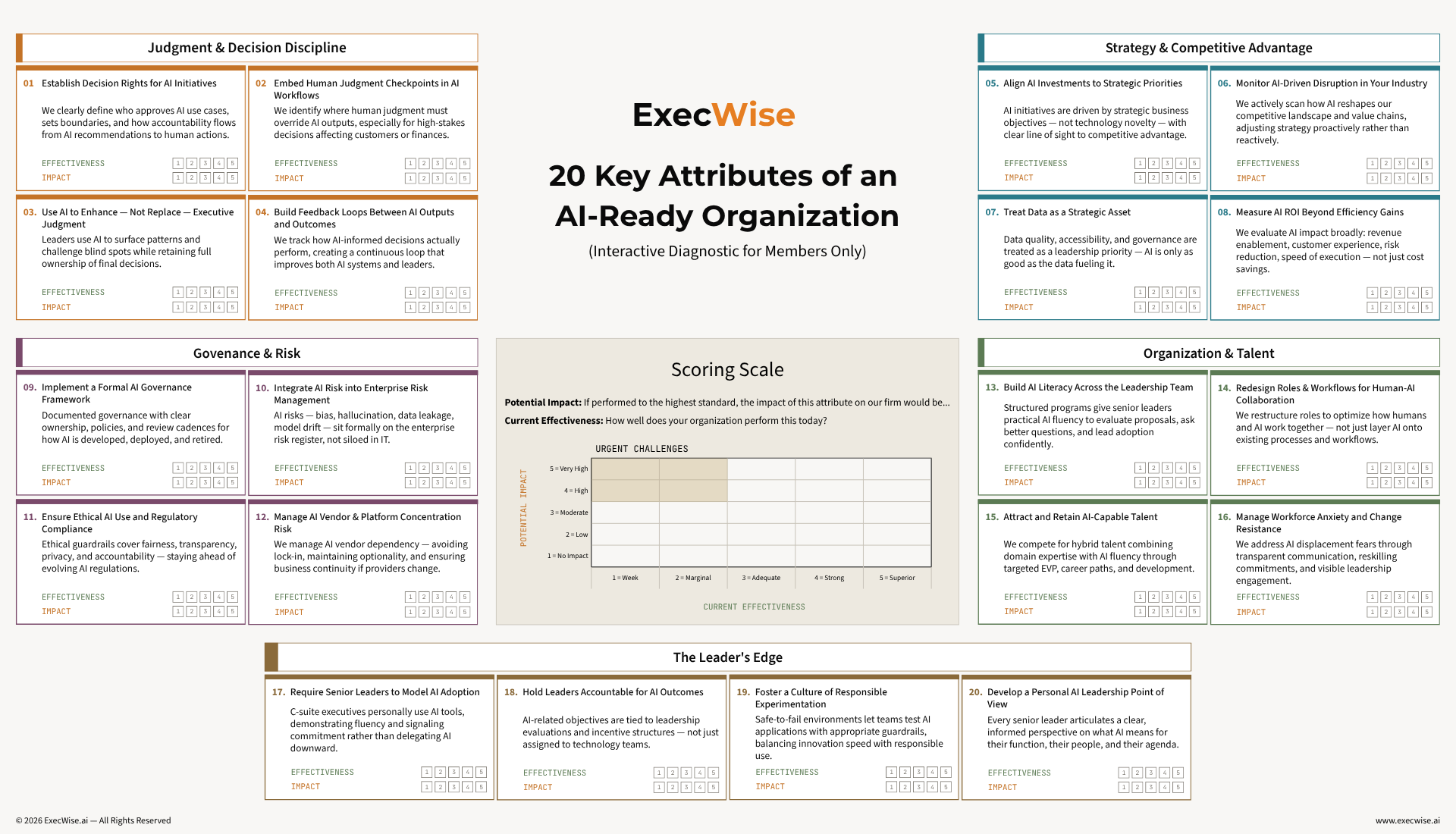
The Anatomy of an AI‑Ready Organization

Rate your organization across 20 research-grounded attributes, five leadership dimensions, and dual-axis scoring. The gap between potential impact and current effectiveness reveals your most urgent AI readiness priorities — with curated insight pathways to act on immediately.

Anatomy of an AI-Ready Organization
Click to expand full anatomy canvas
Learn more about member diagnostics →
Answers inform. Questions activate.
ExecWise uses structured, research-informed inquiry to help lean-org leaders see what they were not seeing — and strengthen the judgment AI cannot replace.
Leaders don’t browse ExecWise. They get pulled through it.
Early Adopter Feedback
What members are saying

I came in sceptical. We’re a mid-sized firm and I assumed this was built for companies with dedicated AI teams. It wasn’t. The 7-day trial made that clear within the first hour. The Anatomy diagnostic alone was worth it — it gave us a structured starting point we’d been missing.

CG
Chief Operating Officer
Regional Financial Services Firm

We had board pressure on AI but the leadership team wasn’t aligned on what that even meant. The Leadership Team AI Alignment Scorecard showed us exactly where our thinking diverged. That conversation was overdue by six months.

CS
Chief Strategy Officer
Professional Services Firm

We’re a mid-size company without a formal AI leadership structure in place. We didn’t even know what the options were. The Operating Model Designer helped us see what a reporting structure could look like for an organisation our size — and gave us a realistic starting point to work from.

NP
Chief Data Officer
Mid-Size Healthcare Company

The biggest shift for me was not starting from scratch every time. The tools and templates give you a solid foundation — you're building on something, not staring at a blank page. That alone saves hours.

RK
Chief People Officer
Consumer Goods Company
Start Your 7-Day Full Access Trial →
No credit card · Full platform access · Use it on a real decision this week
Navigators

AI Literacy Is Everywhere. Decision Architecture Is Not.

Most AI education for leaders focuses on technology literacy, trend briefings, or high-level risk checklists. It explains how models work, showcases emerging use cases, or outlines governance principles. And almost all of it is designed for large enterprise audiences — assuming dedicated AI teams, large budgets, and established governance infrastructure. What it never addresses is the harder question facing the leader of a 10–250 person organisation today: how do you make AI strategy, governance, vendor, and team-adoption calls when there is no CHRO, no CIO, no procurement function, and no consulting budget — and the next decision is on your desk this week?

As AI capabilities commoditise, technical access is no longer the differentiator. Judgment is. The lean organisations that outperform will not be those with “more AI,” but those whose leaders make better decisions about it — faster, with less to lean on, and with consequences that land harder when they get it wrong. Founders, executive directors, principals, partners, and small leadership teams are not looking for another course or certification. They need something fundamentally different: a private, self-paced, continuously updated system that helps them think clearly about AI’s impact on the choices they actually make — in real time, as the landscape evolves.

ExecWise exists to operate at that altitude. It is not a content library, a hype digest, or a workforce learning platform. It is a structured decision operating system built for the leader who is also the board, the CHRO, the CFO, and the IT department. Every topic is built around real lean-org tensions — speed versus oversight, automation versus dissent, adoption versus accountability — and translated into concrete mechanisms: how to make AI tool decisions you can defend, where human override actually matters, what your stakeholders should be asking, and how to respond when something goes wrong without an enterprise crisis function to lean on.

The goal is not to make leaders more informed about AI. It is to make them more disciplined in how they decide about it.

How does this work in practice?
The Question Path: Our Methodology →
Questions or feedback? [email protected]

The Back Story

The story behind the platform and why it was built this way.

Shaurav Sen
Founder
Shaurav Sen

After 32 years in executive development — across Unilever, Corporate Executive Board, Korn Ferry, Gartner, and the Center for Creative Leadership — the conventional next step would have been to start a boutique advisory practice. One-to-one coaching. A handful of clients. Deep work, high fees, limited reach.

ExecWise is a different bet. AI is the single most consequential force reshaping how organisations operate, compete, and govern — and the leaders making the highest-stakes decisions about it are, in most cases, doing so without structured support designed for their reality. This is especially true for the leaders of lean organisations — the founders, executive directors, principals, and small leadership teams running 10–250 person businesses and nonprofits, where the AI decisions carry the same consequences as in large enterprises but the advisory infrastructure simply does not exist. The content that exists is either too technical, too generic, or built for a Fortune 500 reality that does not apply.

This platform was built to close that gap: a structured, always-on and updated decision resource for the leaders of lean organisations navigating AI — combining deep domain expertise with a platform model that makes it accessible to leaders who do not have an enterprise advisory budget and never will. That accessibility is intentional, not a compromise. The pricing reflects a model designed for scale, not a product that cuts corners.

Shaurav is the author of Training Is Broken: Learning Doesn’t Have to Fail (2026). ExecWise is built on the book’s central argument: that meaningful development doesn’t come from content delivery — it comes from triggering curiosity and activating the emotional relevance that makes leaders engage deeply with what they’re learning.

How This Platform Was Built

The questions, frameworks, and diagnostics on ExecWise didn’t come from a research lab or a content team. They came from three decades spent in leadership rooms — facilitating board-level discussions, leading C-suite offsites, and working directly with hundreds of leaders across every size of organisation, from founder-led businesses to global corporations. That pattern recognition — knowing what resonates with a leader under pressure, what altitude their decisions actually live at, what kind of provocation they respect versus what they dismiss — is the foundation everything else is built on.

The platform itself was developed in close collaboration with multiple advanced AI systems — Claude, ChatGPT, Gemini, Grok, and Perplexity. This was not a case of asking a chatbot to generate a learning platform. Each model played a specific role in a structured, human-directed process:

Research and source identification — surfacing relevant academic research, practitioner frameworks, and strategic literature, bounded by strict quality and credibility filters.

Content development and pressure-testing — drafting, challenging, and refining question sets through iterative exchanges. Stress-testing scenarios. Filling gaps.

Cross-validation — one model’s output routinely checked by another to reduce blind spots and surface inconsistencies.

Platform engineering — coding, testing, and debugging every feature through human-AI collaboration.

Fact-checking and citation integrity — every source, claim, and URL verified multiple times.

Throughout this process, frameworks and content were also reviewed by a professional network of ex-colleagues, senior leaders, and trusted peers — including founders and executive directors of lean organisations who are the platform’s primary audience. Their feedback ensured the work reflected how lean-org leaders actually think, decide, and learn — not how AI models or large-enterprise consulting frameworks assume they do.

Why a Platform, Not a Practice

There is no shortage of excellent executive coaches, facilitators, and advisors. But the traditional model has a structural limitation: it depends on individual time, which means high fees and limited reach. The best AI advisory support has historically been reserved for leaders inside the largest organisations — where dedicated AI strategy teams, management consultants, and board advisors are on retainer. For the leaders of lean organisations — the founders, executive directors, principals, and small leadership teams running 10–250 person businesses and nonprofits — that quality of structured thinking has effectively been unavailable. Not because they didn’t need it. Because nobody built for them. ExecWise was built to change that.

ExecWise was built on the belief that this doesn’t have to be the case. A well-designed platform — grounded in real domain expertise, continuously updated, and available on demand — can deliver structured, decision-grade support at a price point that makes it accessible to any leader of a lean organisation. Not as a replacement for coaching or advisory relationships, but as the always-available resource that sits alongside them — ready when the next high-stakes AI decision lands on your desk.

For more information please contact: [email protected]

Content Integrity

How we build, verify, and maintain the quality of everything on this platform.

The responses across ExecWise have been developed using multiple AI models working in concert — including models dedicated specifically to verifying the accuracy of claims, the credibility of sources, and the reliability of references cited. Every response has been structured, reviewed, and refined to meet a standard appropriate for serious lean-org leaders who will act on what they read.

That said, no AI-generated content — regardless of how carefully it is engineered and reviewed — is immune to occasional errors. A source URL may have changed since the response was produced. A statistic may reflect a publication that has since been updated. A nuance in a complex topic may warrant deeper examination than any single response can provide. We believe in being transparent about this rather than pretending otherwise.

We encourage leaders to treat ExecWise the way they would treat any high-quality advisory input: as a trusted and well-researched starting point — not as a final authority. The references included with each response are there precisely so you can verify, explore further, and form your own informed judgment.

A few things worth noting:

These challenges are inherent to all AI-generated content today. Every major AI platform — including ChatGPT, Claude, Gemini, and others — carries similar limitations around accuracy, source reliability, and content currency. This is not unique to ExecWise, though we do not offer that as an excuse.

ExecWise applies more safeguards than most. The use of multiple AI models for cross-verification, curated source selection, structured prompt engineering, and human review represents a level of quality control that goes well beyond what a typical AI interaction provides — or what most users would apply on their own.

External sources are outside our control. Books go out of print, reports get updated, URLs change, and organizations revise their published findings. Where a reference no longer resolves or a source has been updated, the underlying insight in the response will typically still hold — but we recommend verifying links and publication dates when using specific references in your own work.

We actively maintain and improve content quality. As AI models improve and new research becomes available, ExecWise responses will be reviewed and updated to reflect the best available thinking. This is a living platform, not a static publication.

Privacy & Security

How ExecWise handles your data — written in plain language, not legal boilerplate.

Our commitment in one paragraph

ExecWise is a decision-support platform for the leaders of lean organisations. We collect only the information needed to deliver the service. We do not sell, rent, share, or monetise your data — ever. We do not run advertising. We do not use your data to train AI models. We do not send unsolicited marketing emails. Your data exists to serve you, and when you leave, it is deleted.

What we collect and why

Account information

Your email address is collected when you sign up for a trial or membership. This is used solely for account authentication and essential service communications. We do not add your email to marketing lists, sell it to third parties, or use it for any purpose beyond operating your account.

Platform activity

As you use ExecWise, the platform stores your engagement data locally in your browser: diagnostic results, completed Decision Lab templates, BlindSpot Detector outcomes, navigator progress, saved favorites, and AI Bridge preferences. This data powers your personal dashboard and is not transmitted to ExecWise servers unless you are a paying member with cloud sync enabled.

Payment information

All payment processing is handled by Stripe, a PCI DSS Level 1 certified payment processor. ExecWise never sees, stores, or has access to your credit card number, bank details, or billing credentials.

What we do not collect

No personal identifiers beyond your email address
No browsing behavior, cookies, or tracking pixels
No third-party advertising integrations
No employer or organizational data
No data sold, rented, or shared with anyone — for any reason

Infrastructure and security

ExecWise is hosted on Cloudflare, which delivers enterprise-grade security, DDoS protection, and SSL/TLS encryption on all connections. All data transmitted between your browser and ExecWise is encrypted in transit via HTTPS.

The AI Thought Partner feature uses the Claude API (by Anthropic) via serverless functions. Your questions are processed in real time and are not stored, logged, or used for model training by either ExecWise or Anthropic.

Data retention

During a 7-day trial

Everything you do is saved — diagnostic results, progress, favorites, Decision Lab outputs.

After the trial ends

Your data is retained for 30 days. If you become a member within that window, you pick up exactly where you left off.

If you cancel

Your data is retained for 30 days after your membership ends, then permanently deleted. You can request immediate deletion at any time by contacting us.

GDPR and your rights

You have the right to access, correct, delete, or port your data at any time. To exercise any of these rights, contact us at [email protected]. We will respond within 30 days.

Questions?
Privacy, data, and security inquiries:
[email protected]

Last updated: March 2026

ExecWise is built for the leaders of lean organisations — founders, CEOs, executive directors, principals, partners, and small leadership teams running businesses and nonprofits between 10 and 250 people. The people who must make the AI calls themselves — on strategy, vendor choice, governance, team adoption, and risk — without an enterprise advisory infrastructure to lean on. It is not a workforce learning tool, a technical certification, or a general AI literacy platform. Every question, every response, and every pathway is sized for the reality of a leader who is also the board, the CHRO, the CFO, and the IT department.

Executive coaches and senior advisors working directly with CXO clients may also find ExecWise valuable — as a structured resource that helps them bring sharper, more informed perspectives to the leaders they serve.

There are — and each has a real gap.

Executive education and conferences offer broad exposure but rarely go deep enough into the specific questions a leader needs answered for their context. Management consultants can go deep, but their advice often comes shaped by the firm’s own frameworks and commercial interests — and at a price point accessible only to the largest organisations. AI copilots and chatbots are accessible and fast, but depend entirely on the quality of what you ask. Technology vendors will gladly educate you, but their guidance inevitably tilts toward their own offerings.

More importantly, almost all of these alternatives are designed with large enterprises in mind. Senior leaders in mid-sized organisations — where the AI decisions are just as consequential but the advisory infrastructure does not exist — are largely left to make do with content built for a different audience entirely. What they rarely address is the harder question: how should you redesign decision rights, oversight structures, and accountability systems in an AI-augmented organisation, when you do not have a dedicated AI team or a consulting retainer to lean on? As AI capabilities commoditise, technical access is no longer the differentiator. Judgment is — and the leaders who outperform will be those with better decision architecture, not simply more AI.

ExecWise sits in a different category entirely. It is not a content library, a trend digest, or a workforce learning platform. It is a structured decision-support system built for the leader of a lean organisation navigating AI — built around real lean-org tensions like speed versus oversight, automation versus dissent, and adoption versus accountability. Every topic translates into concrete questions: how to make decisions you can defend without an enterprise governance function, where human override actually matters, what your stakeholders should be asking, and how to respond when something goes wrong.

Pre-engineered expert questions, structured inquiry pathways, curated and verified sources, and quality-reviewed responses — all designed specifically for the altitude where consequential, high-stakes decisions are made. No commercial conflicts. No time constraints. No dependence on knowing what to ask before you arrive. Just a clear, trusted path to sharper thinking about what matters most.

Thought Partner is ExecWise’s AI-powered leadership advisor. You can ask it any question about AI strategy, governance, vendor decisions, team adoption, or your own judgment as a lean-org leader — and it will synthesize a response drawn exclusively from the platform’s curated content.

Unlike a general-purpose chatbot, Thought Partner operates within strict boundaries. It can only draw from the researched, quality-verified content inside ExecWise — the same content that powers the 15 navigators across five leadership dimensions. This means you get relevant, grounded guidance rather than generic AI output. Each response includes “Explore Deeper” links that connect you directly to the relevant navigators, so you can move from a quick answer into the structured inquiry the platform is designed around.

General AI tools are powerful but unconstrained. Ask ChatGPT about AI governance, and you’ll get a plausible-sounding answer — with no quality controls, no source verification, and no guarantee the advice applies to your context as a senior leader. The deeper problem isn’t how you ask — AI models are increasingly good at refining vague prompts into polished responses. The problem is knowing what to ask in the first place. A leader who hasn’t studied how AI reshapes organizational design won’t think to ask about structural coupling versus coordination costs — no matter how helpful the chatbot’s prompt suggestions are. ExecWise exists because that knowledge gap is human, not technological.

Thought Partner is the opposite of an open-ended chatbot. It operates on a curated content library built specifically for the leaders of lean organisations. Every response is bounded to this verified material. You get synthesis, not summarization. Perspective, not platitudes. And when it doesn’t have enough content to answer a question well, it tells you — rather than making something up.

ExecWise solves the “don’t know what to ask” problem by doing the hard work before you arrive. Every navigator contains pre-engineered questions designed by someone with over three decades in leadership development who knows — from working with hundreds of leaders across every size of organisation — which questions actually unlock insight versus which ones produce comfortable but forgettable answers. These are not questions generated by AI. They are questions crafted through expertise and then used to generate responses under controlled, quality-managed conditions.

You could spend hours researching the right sources and reviewing outputs for accuracy. ExecWise is what that process looks like after it’s already been done — rigorously, systematically, and with quality controls most leaders would never apply on their own.

Bounded Intelligence is the design philosophy behind Thought Partner. It means the AI is deliberately constrained to operate only within the boundaries of ExecWise’s curated content library. It cannot hallucinate, speculate, or pull from the open internet.

Every response is grounded in content that has been researched, written with quality controls, and verified with cited sources. The “bounded” part is the point — it’s what makes this different from asking ChatGPT or Claude a question cold. The intelligence is real; the boundaries make it trustworthy.

My AI Bridge is an optional member feature that connects ExecWise’s structured questions to the AI tool you already use — ChatGPT, Copilot, Claude, Gemini, Grok, or Perplexity. It is designed for a specific type of member: someone who uses an AI tool regularly enough that their AI has built up real personal context — how they think, how they prefer to receive information, their professional background and working style. For those members, My AI Bridge combines ExecWise’s structured leadership framing with their AI’s deep knowledge of how they work, so the response they get is both well-framed and genuinely personalized.

Do you need it? No — and this is worth being direct about. ExecWise responses are the core product. They are researched, structured, and built specifically around the questions in each navigator. Most members get everything they need from them directly. My AI Bridge is an extension for those who have already built significant context in their own AI tool and want to combine that with ExecWise’s structure. If that doesn’t describe how you use AI tools yet, you’re not missing anything by skipping it. Learn more about My AI Bridge →

This is the most important question, and it’s where the process behind ExecWise matters most.

Each response draws from a curated mix of sources — peer-reviewed studies, institutional reports (McKinsey, Stanford HAI, Wharton, MIT Sloan, Deloitte), established books by recognized thinkers, and where appropriate, classical texts that genuinely illuminate the topic. Sources are selected because they represent the strongest available evidence or sharpest available thinking on the question being addressed.

Every response was engineered to present honest, balanced analysis rather than advocacy. The questions are designed to surface tensions, trade-offs, and uncomfortable implications — not to confirm what you already believe. Where a topic is genuinely contested, the responses acknowledge that rather than presenting one perspective as settled truth.

The responses were not generated and published untouched. A detailed review process was applied — checking for accuracy of claims, quality of reasoning, appropriateness of sources, and whether the response addressed the question at the level a serious lean-org leader would expect.

No content should be accepted uncritically — ExecWise included. But the gap between an unstructured conversation with a general-purpose AI and a professionally engineered, source-verified, human-reviewed experience is substantial. That gap is what ExecWise exists to fill.

This confuses two different problems. AI models are getting better at interpreting vague intent and generating fluent responses. But ExecWise doesn’t exist because AI can’t understand your questions — it exists because you don’t yet know which questions matter. That’s a human knowledge gap, not a technology gap.

A leader who hasn’t deeply studied how AI reshapes organizational design doesn’t know to ask about structural coupling versus coordination costs. No amount of AI improvement changes that. In fact, as AI answers improve, the penalty for asking the wrong question gets worse — you’ll get a beautifully fluent, confidently delivered response that takes you in the wrong direction.

ExecWise works like a skilled mentor, not a crutch. A great mentor doesn’t ask questions you’d eventually think of on your own — they ask questions that reframe how you see the problem. Once you’ve been through that reframing, you can’t unsee it.

The navigators model what expert-level inquiry looks like so that over time, you internalize the patterns: how to challenge assumptions, how to move from understanding to application, how to connect implications across domains. The goal isn’t that you use ExecWise forever. It’s that after engaging with enough navigators, you start asking those kinds of questions yourself — and bring sharper thinking to every AI tool, advisor conversation, and strategic decision that follows.

It depends on how you use the platform. There are three ways in, each designed for a different time commitment and intent:

The AI Leadership Scan takes under a minute to generate — select your role and AI maturity stage, and you get a structured read across five leadership dimensions with priorities, blind spots, and deeper questions to explore. From there, you can dive into any of the 15 Topic Navigators at your own pace — each question and response takes under ten minutes.

Moments That Matter starts from the situation you’re facing right now — a board question, a vendor pitch, a team misalignment — and directs you to the most relevant insights, tools, and frameworks. Five to ten minutes gets you what you need.

The Thought Partner allows for just-in-time usage — drop in with a single question and get a focused, synthesized answer in minutes when you need a quick perspective on a pressing decision.

No schedule, no cohort, no deadline. You decide what to focus on, when, and how deep to go. The platform is designed around the reality that the scarcest resource for any lean-org leader isn’t access to information — it’s time to think clearly about the right information.

ExecWise is built on a simple conviction: earn your trust before asking for your commitment. A significant portion of the platform is available to every visitor — no account, no sign-up, no friction. Explore the diagnostics, test the navigators, try the Thought Partner, and decide for yourself whether ExecWise delivers what it promises. If it does, membership is how you go deeper and you can learn more here.

Still have questions? [email protected]

Our Methodology

The science behind how ExecWise uses structured inquiry to strengthen lean-org leaders’ judgment.

ExecWise.ai

The Question Path

Our Methodology

Most platforms deliver answers. ExecWise begins with questions — because the right question, at the right moment, changes how a leader thinks.

The Science

George Loewenstein’s Information-Gap Theory demonstrates that curiosity spikes when people become aware of a specific gap between what they know and what they need to know. A precisely worded question is the cleanest way to open that gap. Once opened, the drive to close it becomes almost irresistible.

This is not clickbait. This is cognitive science applied to leadership development.

Five Design Principles

01

Precise Cognitive Tension

Each question targets a specific knowledge gap. Instead of telling lean-org leaders what to think, we surface fault lines in reasoning: What assumption is driving this decision? What incentive is no one naming? What would have to be true for this to fail?

02

Surface-to-Depth Inquiry

Questions progress from immediate operational concern through strategic reframing, structural tension, and governance implication — to identity-level reflection. This mirrors how expert inquiry naturally works and sustains forward motion.

03

Payoff Protects Trust

Curiosity hooks only build trust when the answer delivers. Every question must surface a legitimate tension, provide structural clarity, and withstand board-level scrutiny. Curiosity focuses thinking — it never manipulates it.

04

Navigation Architecture

Each question signals depth, acts as a diagnostic, and invites escalation. Users self-select into deeper inquiry because they recognize themselves in the tension. The question path is the navigation layer.

05

Protecting Judgment in the AI Era

AI scales information — it does not scale disciplined inquiry. ExecWise’s question architecture strengthens judgment, surfaces blind spots, exposes incentive distortion, protects cognitive independence, and preserves decision quality in AI-saturated environments. If users feel “pulled forward,” it is because the questions expose unresolved strategic tensions — and resolve them with substance.

The Inquiry Progression
“What should I do?”
“What are we missing?”
“What kind of leader does this moment require?”
← Previous: Back Story Next: Content Integrity →

The questions AI raises for leaders aren't new. How do you act decisively under uncertainty? Hold power without being consumed by it? Lead when the rules are being rewritten?

These questions have been answered with extraordinary depth across thousands of years of human thought. The texts in this section aren't decorative additions — they are among the most rigorously tested frameworks for judgment, discipline, and self-command ever produced. Each navigator applies the same structured inquiry approach used throughout ExecWise: curated questions, structured responses, and reflection prompts connecting timeless principles to the decisions you're facing now.

Select a navigator to explore through the lens of your role and purpose.

ExecWise · Tools › Diagnostics

Diagnostics

Five scenario-based diagnostics and nine BlindSpot Detectors — none of them quizzes or surveys. Each one puts you inside a real leadership situation and generates a named profile, a vulnerability map, or a personalised action pathway. The BlindSpot Detectors are tied directly to the nine Moments That Matter — six scenarios, under two minutes each. Results are saved to your Dashboard.

Members Only
Flagship Diagnostic
The Lean AI Anatomy
The flagship diagnostic for lean organisations. 12 attributes across five leadership dimensions, sized for a 10–250 person org. Generates a prioritised action pathway in 12–15 minutes.
Members Only
Diagnostic 01
AI Stance Diagnostic
20 scenario-based questions across four phases diagnose your individual AI leadership stance — generating a named profile, signature strengths, and development edge.
Members Only
Diagnostic 02
AI Vulnerability Radar
18 scenario-based questions map your lean-org AI vulnerability across five dimensions. Output: a prioritized vulnerability profile with recommended actions sized for your scale.
Members Only
Diagnostic 03
AI Investment & Decision Readiness
Assesses your readiness to evaluate, fund, and govern an AI investment before committing money you can’t easily get back. Sized for the AI bets a lean org actually makes.
Members Only
Diagnostic 04
AI Use Case Prioritization
14 questions across four phases identify the most sensible AI use-case arenas for your lean org — based on your goals, operating context, readiness, and constraints. Output: a Starting Profile, top three use-case arenas, and First Experiment Blueprint. 15–20 minutes.
Members Only
Detector · 9 available
BlindSpot Detectors
One detector per Moment That Matters. Six scenarios, under two minutes each. Reveals which dimension you’re overlooking and recommends the specific questions you should start asking.

These tools are available exclusively to ExecWise members. Start your 7-day free trial for full access — no credit card required.

ExecWise · Intelligence

AI Essentials

There is a specific kind of vulnerability that affects otherwise excellent leaders right now: being forced to make consequential AI decisions without the knowledge to interrogate them. Not because they lack intelligence, but because the foundational concepts were never explained at the right level for their role.

This section addresses that directly. The fifty-three questions here cover what AI actually is, why it behaves the way it does, how the technology works at the level that matters for governance, and where it sits in your organisation and the broader landscape. The goal is not to make you a technologist. It is to give you the fluency to ask better questions, spot weaker answers, and lead with confidence rather than deference.

Each answer is written for a lean-org leader who needs to act on it, not for a technologist. No assumed background. No jargon left unexplained. The test for every answer: does this help you govern, decide, and challenge more effectively?

53 questions
WHAT — Core Concepts and Definitions
53 questions. Members only.
Full access to all WHAT, WHY, HOW and WHERE questions is available with a membership.
ExecWise · Intelligence

AI in Practice

The cases in this library are not here to impress you. They are here to provoke a question — one that applies to your organisation, your context, and the decisions in front of you right now.

Each example has been selected because it is publicly documented and independently reported. We have not included vendor case studies, anonymised examples, or claims that cannot be traced to a named source.

Most documented AI cases come from large organisations — they move first and report publicly. But the decisions, the patterns, and the underlying principles translate directly to lean organisations facing the same pressures with fewer resources and less margin for error. A 60-person professional services firm can apply the same pull-model adoption logic as a global bank. A regional nonprofit can use the same “narrow and measurable first” discipline as a Fortune 500 finance team. Read for the insight, not the brand — and apply it at your scale.

These are not benchmarks to chase. They are thinking triggers.

How to use this section

Read across roles and industries, not just your own. Ask yourself: what is the underlying idea here, and what would it look like in my world?

Updated Q1 2026 · Sources verified
Filter by lean-org function
20 use cases
Founder / LeaderJPMorgan Chase
Financial Services

How do you scale AI across 60,000 people without making it a compliance exercise?

What they built

JPMorgan built an internal generative AI assistant and deployed it to over 60,000 employees — not through mandate, but through a deliberate pull model. They tracked tool-level usage patterns rather than individual compliance.

What was reported

Broad AI adoption across the enterprise, driven by utility rather than policy.

Money & RiskFanatics
Sports / Retail

How do you apply AI to financial forecasting without losing your ability to interrogate the model?

What they built

Fanatics integrated AI into their financial forecasting process, setting a deliberate policy of narrow, measurable use cases first — focusing on demand forecasting for licensed merchandise before expanding scope.

What was reported

Improved forecast accuracy in targeted categories, with finance leadership maintaining direct oversight of model assumptions.

20 use cases. Members only.
Full access to all 20 cases — coded by lean-org function — is available with a membership.
ExecWise · Intelligence

AI Agents

Most organisations are still governing AI as if it only answers questions. It no longer does. AI agents act — they book, execute, decide, and trigger other agents without waiting to be asked. The governance frameworks built for AI models that respond to prompts are structurally inadequate for AI that initiates and operates autonomously.

This is not a future concern. Agentic AI is already embedded in enterprise software, customer-facing systems, and internal workflows — often without explicit governance sign-off. The pace of adoption is accelerating faster than most leadership teams have had time to respond to, and the window for establishing sensible oversight before consequential failures occur is narrowing.

This section exists because agentic AI is the single most important governance frontier for lean-org leaders right now — and the least adequately addressed in most organisations.

A note on terminology

An “AI agent” is any AI system that takes actions in the world — not just generates text. If it does something rather than just says something, it is an agent. The governance implications are fundamentally different.

01
Foundations
What is an AI agent — and why does it change your governance model?
02
Authority
Decision rights for agents
03
Oversight
Multi-agent oversight
04
Control
Kill switch protocols
05
Detection
Shadow agent detection
06
Procurement
Procurement and vendor accountability when agents are embedded
07
Accountability
Liability and board disclosure
7 governance modules. Members only.
Full module content including governance frameworks and board questions is available with a membership.

A significant portion of the platform is available to every visitor — no account, no sign-up, no friction. Explore the AI Leadership Scan, test the navigators, try the Thought Partner, and decide for yourself whether ExecWise delivers what it promises. If it does, membership is how you go deeper.

Membership unlocks the full depth — and keeps it current as AI reshapes executive leadership.

Full Platform Access
Complete access to all curated content and research-based insights across 15 AI Navigators, 400+ questions, and 5 leadership dimensions — nothing restricted.
Thought Partner
Your on-demand AI advisor — ask any question, get a grounded synthesis from curated platform content. Available whenever you need it.
Anatomy of an AI‑Ready Organization
Rate your organization across 20 research-grounded attributes, five leadership dimensions, and dual-axis scoring. Reveals your most urgent AI readiness priorities — with curated pathways to act on immediately.
Diagnostics & BlindSpot Detectors
20+ advanced diagnostics, AI-powered Decision Labs, editable board-ready templates, and scenario-based BlindSpot Detectors that surface the risks and assumptions you’re not seeing.
Save, Resume & Refer Back
Favorite any content, save diagnostic results, and pick up where you left off — your personal dashboard is always ready when you are.
Question of the Day
A thought-provoking question with a detailed, research-backed response on navigating your AI priorities — delivered to your inbox every day.
  • Thought Partner — UnrestrictedFull, unlimited access to ExecWise’s AI-powered Bounded Intelligence engine. Ask any question about AI strategy, governance, vendor decisions, team adoption, or your own judgment as a lean-org leader. Includes profile personalization, session history, and deep-linked navigation.
  • Full Navigator AccessAll questions across all four use cases — Understand, Assess, Apply, and Communicate — unlocked in every one of the 15 Topic Navigators and 2 Ageless Wisdom Navigators. 400+ structured questions with cited, quality-verified responses.
  • The Anatomy of an AI-Ready Organization FlagshipA comprehensive organizational diagnostic built on 20 research-grounded attributes across five leadership dimensions. Dual-axis scoring reveals the gap between potential impact and current effectiveness. Output: a structured priority report with curated insight pathways. 15–20 minutes.
  • AI Stance Diagnostic20 scenario-based questions diagnose your individual leadership stance across five AI-era dimensions — generating a named profile, signature strengths, and a sequenced navigator pathway. 18–22 minutes.
  • AI Vulnerability Radar18 scenario-based questions map organizational AI vulnerability across five dimensions — Strategic Coherence, Governance Integrity, Talent & Capability, Operational Exposure, and Signal Quality. 15–20 minutes.
  • AI Investment Diagnostic14 scenario questions across five investment judgment dimensions. Output: a named Investment Profile, Alignment Map, and personalized Investment Framework. 15–18 minutes.
  • AI Use Case Prioritization14 questions identify the most sensible AI use-case arenas for your organisation. Output: Starting Profile, top three arenas, and a First Experiment Blueprint. 15–20 minutes.
  • Org AI Readiness Pulse Coming SoonCompleted on behalf of your organization. Rates AI readiness across five dimensions and generates a team-level readiness map for leadership discussion.
  • 9 BlindSpot DetectorsScenario-driven detectors across each of the 9 executive AI priorities. Surfaces what you’re likely missing — generating a personalized blind spot analysis with recommended questions and actions.
  • Decision LabsSix interactive tools: AI Operating Model Designer, AI Decision Brief Builder, AI Business Case Stress Test, AI Governance Policy Builder, Leadership Team AI Alignment Scorecard, and the flagship AI Scenario Simulation Lab. Each generates a structured output you can act on or bring directly into a meeting.
  • Guides & ArtifactsFive board-ready templates and frameworks: AI Governance One-Pager, 12 Questions Your Board Will Ask About AI, AI Vendor Evaluation Scorecard, AI Strategy Session Blueprint, and AI Ethics & Acceptable Use Policy.
  • 9 Moments That MatterCurated insight pathways for the 9 moments where AI intersects with executive responsibility — from board pressure to organizational redesign. Each includes recommended questions, tools, and diagnostics.
  • Personal Learning DashboardTrack your progress, save diagnostic and detector results, retrieve saved responses, and review your AI Leadership Scan results across the platform.
  • AI Leadership ScanA guided intake that calibrates the platform to your role, industry, and AI maturity stage. Generates a personalized executive digest covering all four use cases.
  • My AI BridgeAn optional feature for members who already use an AI tool regularly. Combines ExecWise’s structured questions with your AI’s personal knowledge of how you work — one click from any navigator response.
  • Continuously RefreshedReal-time updates to existing content plus structured quarterly additions — so the platform stays relevant as the AI landscape shifts.
Ready to go deeper?
Individual and team pricing — simple, transparent, cancel any time.
Take the full platform for a risk-free test drive. No credit card needed.
Have questions about membership or the platform? [email protected]
What is My AI Bridge?

My AI Bridge is an optional feature for a specific type of member: executives who already use an AI tool regularly and have built up meaningful context in it over time.

Their AI knows how they think, how they prefer to receive information, and has absorbed months of professional interaction. For those members, My AI Bridge lets them combine ExecWise’s structured leadership questions with that personal AI context — in one click.

If you don’t use an AI tool regularly, you don’t need this. ExecWise responses are researched, structured, and complete on their own. Most members will get everything they need from them directly.

How it works in practice
ExecWise
Asks the right question. Delivers the structured response. Provides the frameworks your AI won’t know to apply.
🌐
My AI Bridge
Enriches the question with your role, industry, and diagnostic profile. One click sends it.
🤖
Your AI
Receives the question already framed with your context. Answers at a depth and relevance it couldn’t reach on a cold prompt.
Who should consider it

My AI Bridge is worth setting up if you use ChatGPT, Copilot, Claude, or another AI tool as a regular thinking partner — and you’ve had enough interactions with it that it understands your context, your preferences, and your way of working. If its responses to you feel noticeably more tailored than what a fresh prompt produces, that’s the signal. For those members, My AI Bridge means ExecWise’s structure and their AI’s personalization work together rather than separately.

Who doesn’t need it: ExecWise responses are built to be substantive and specific — not generic summaries. They’re researched, referenced, and structured around the exact question you’re exploring. For most members, they’re the primary resource. My AI Bridge is an option, not an upgrade.
What gets sent to your AI — and what doesn’t
✓ Sent
  • The navigator question
  • The full framing and context
  • Your role and industry
  • Your diagnostic profile (if taken)
  • Your preferred response style
✕ Never sent
  • Your AI conversations
  • Your AI account or credentials
  • Any background activity
  • Anything you haven’t explicitly set
My AI Bridge is a one-way send. It does not connect to your AI account, read your conversations, or run in the background. It simply copies an enriched prompt and opens your chosen AI tool. That’s it.
Supported AI tools
ChatGPT
ChatGPT
Seamless
Copilot
Copilot
Seamless
Perplexity
Perplexity
Seamless
C
Claude
Clipboard
Gemini
Gemini
Clipboard
Grok
Grok
Clipboard
Seamless — the enriched prompt loads directly into a new chat window. Clipboard — the prompt is copied to your clipboard and the tool opens in a new tab; paste once to send.
My AI Bridge is a member feature
Available to all paid members. Set up once in under two minutes — then available on every navigator response across the entire platform.

Simple. Transparent. No surprises.

Full platform access for every member. Choose the commitment that fits — individually, or for your closest 2–4 people. Verified nonprofit pricing available on request.

Monthly
Monthly Access
$ 99 /month

Billed monthly

No lock-in. Cancel any time.

Full access to the entire content and insights library
Thought Partner — your on-demand AI leadership advisor
Advanced diagnostics, Decision Labs, and BlindSpot Detectors
Stakeholder-ready templates, guides, and one-page artefacts
Personal dashboard with progress tracking — continuously updated
Annual · Best Value
Annual Access
$ 999 /year

Save with annual — two months free

No lock-in. Cancel any time.

Full access to the entire content and insights library
Thought Partner — your on-demand AI leadership advisor
Advanced diagnostics, Decision Labs, and BlindSpot Detectors
Stakeholder-ready templates, guides, and one-page artefacts
Personal dashboard with progress tracking — continuously updated
Equip Your Closest People

Purchase access passes and distribute them across your closest 2–4 people, your advisory group, or your board. Each pass holder receives full, individual platform access — identical to an individual member.

5 Access Passes
$ 2,500

per year

$500 per pass / year

Request Access
12 Access Passes
$ 5,000

per year

$417 per pass / year

Request Access
20 Access Passes
$ 7,500

per year

$375 per pass / year

Request Access
Full platform access per pass holder
Distribute across exec team, board, or both
Single annual invoice — fully expensable
Cancel any time — no lock-in
For more than 20 access passes, please contact [email protected]
Questions about membership? [email protected]

7-Day Full Access Test Drive.
Full Access. Zero Risk.

ExecWise is not a course, not a content library, not an AI chatbot with generic answers. It’s a structured decision operating system built specifically for the leaders of lean organisations — founders, executive directors, principals, and small leadership teams running 10–250 person businesses and nonprofits, where the AI decisions are just as consequential as in large enterprises but the advisory infrastructure simply does not exist.

The way ExecWise is built — around the non-obvious questions executives should be asking, not the answers everyone is selling — is unlike anything you’ve used before. That means the best way to understand what it does is to use it. Not a demo. Not a webinar. The actual platform, with everything unlocked, for seven days.

Use it the way it’s designed to be used — as a just-in-time resource when you’re confronted with an AI decision that demands sharper thinking. Run a diagnostic before a board meeting. Stress-test a business case before you sign off. Build a governance policy before your next compliance review. Save what matters to your personal dashboard and come back when the next decision arrives. Then decide if this belongs in your leadership toolkit.
What’s Included in Your 7 Days
Full Platform Access
Complete access to all curated content and research-based insights across 15 AI Navigators, 400+ questions, and 5 leadership dimensions — nothing restricted.
Thought Partner
Your on-demand AI advisor — ask any question, get a grounded synthesis from curated platform content. Available whenever you need it.
Anatomy of an AI‑Ready Organization
Rate your organization across 20 research-grounded attributes, five leadership dimensions, and dual-axis scoring. Reveals your most urgent AI readiness priorities — with curated pathways to act on immediately.
Diagnostics & BlindSpot Detectors
20+ advanced diagnostics, AI-powered Decision Labs, editable board-ready templates, and scenario-based BlindSpot Detectors that surface the risks and assumptions you’re not seeing.
Save, Resume & Refer Back
Favorite any content, save diagnostic results, and pick up where you left off — your personal dashboard is always ready when you are.
Question of the Day
A thought-provoking question with a detailed, research-backed response on navigating your AI priorities — delivered to your inbox every day.
What Happens to Your Data
Your data stays yours. We do not use any information you enter — diagnostic responses, Thought Partner queries, or uploaded documents — to train AI models. Our AI is pre-trained. Your data is used only to generate your personal results.
During the trial: Everything you do is saved — diagnostic results, progress, favorites, Decision Lab outputs. Your personal dashboard tracks it all, exactly as it would for a paying member.
After the trial ends: Your data is retained for 30 days. If you become a member within that window, you pick up exactly where you left off — nothing lost, no need to redo anything.
After 30 days without subscribing: Your data is removed. This isn’t a penalty — it’s a data hygiene practice. If you return later and subscribe, you start fresh.
What We Don’t Do
No credit card required
No auto-renewal or charges
No sales calls or follow-ups
No “cancel before you’re charged” traps
No feature restrictions during the trial
Nothing happens if you do nothing

We built ExecWise on a simple conviction: earn your trust before asking for your commitment. The trial is how we put that conviction into practice. If ExecWise delivers what it promises, you’ll know within seven days. If it doesn’t, you’ve lost nothing.

View Pricing & Plans | Questions? [email protected]

Executive Toolkit

Every tool is grounded in ExecWise’s curated content — not generic frameworks. Results link directly to the most relevant Dimensions, so every output connects to deeper platform insight.

✓ Available Free
No account required — start using these tools right now.
QuickStart Diagnostic
Scenario-based questions that pinpoint which of the five leadership dimensions deserves your attention first. Takes less than 3 minutes.
9 BlindSpot Detectors — One Per Moment That Matters
Board Readiness BlindSpot Detector
M1: Reveals what your board preparation is missing. 7 scenarios.
Governance Gap BlindSpot Detector
M2: Reveals where governance intent and reality diverge. 8 scenarios.
Vendor Evaluation BlindSpot Detector
M3: Reveals which critical questions you’re not asking. 7 scenarios.
Team Alignment BlindSpot Detector
M4: Reveals where leadership AI alignment is an illusion. 8 scenarios.
Org Redesign BlindSpot Detector
M5: Reveals which dimension of org change you’re underweighting. 7 scenarios.
Scale Readiness BlindSpot Detector
M6: Reveals what’s missing between “it works” and “it scales.” 7 scenarios.
Change Resistance BlindSpot Detector
M7: Reveals whether you’re diagnosing resistance correctly. 7 scenarios.
Leadership Readiness BlindSpot Detector
M8: Reveals the dimension of readiness you’re overestimating. 8 scenarios.
Decision Quality BlindSpot Detector
M9: Reveals which cognitive trap you’re most vulnerable to. 8 scenarios.
◆ Members Only

Available to paying members and during the 7-Day Full Access Test Drive.

Advanced Diagnostics
AI Stance Diagnostic
20 scenario-based questions diagnosing your leadership stance across five AI-era dimensions. Generates a named profile, signature strengths, development edge, and a sequenced navigator pathway. 18–22 minutes.
AI Vulnerability Radar
18 scenario-based questions mapping your organizational AI vulnerability across Strategic Coherence, Governance Integrity, Talent & Capability, Operational Exposure, and Signal Quality. Output: a prioritized vulnerability profile. 15–20 minutes.
AI Investment Diagnostic
14 scenario questions across five investment judgment dimensions. Generates a named Investment Profile, Alignment Map, and personalized Investment Framework. 15–18 minutes.
AI Use Case Prioritization Diagnostic
14 questions across four phases identify the most sensible AI use-case arenas for your organisation — based on your goals, operating context, readiness, and constraints. Output: a Starting Profile, tiered recommendations, and First Experiment Blueprint. 15–20 minutes.
Org AI Readiness Pulse
Coming Soon
Completed on behalf of your organization. Rates AI readiness across five dimensions and generates a team-level readiness map built for leadership team discussion.
Decision Labs
AI Operating Model Designer
Design your AI leadership reporting structure with a recommended governance archetype and visual org chart.
AI Decision Brief Builder
Structure a decision brief for any AI initiative — ready for board or leadership review.
AI Business Case Stress Test
Pressure-test your AI business case before you sign off.
AI Governance Policy Builder
Build a governance policy framework tailored to your organization.
Leadership Team AI Alignment Scorecard
Assess alignment across your leadership team on AI priorities.
AI Scenario Simulation Lab
A branching narrative simulator where your choices compound. Each session ends with a structured debrief surfacing the patterns in your decision-making.
Guides & Templates
AI Governance Framework
Board-ready one-pager for establishing AI governance principles.
12 Questions Your Board Will Ask About AI
Preparation guide for the AI questions heading your way.
AI Vendor Evaluation Scorecard
Structured framework for evaluating AI vendor proposals objectively.
AI Strategy Session Blueprint
Agenda and discussion framework for running your first AI strategy session.
AI Ethics & Acceptable Use Policy
First-draft framework for establishing organizational AI ethics and use boundaries.
Unlock every tool above — no credit card, no obligation.

Moments That Matter

Nine AI moments every lean-org leader hits. Find the one that’s on your desk this week — and go straight to the thinking, tools, and structured challenge a leader without an enterprise to lean on actually needs.

Each moment takes about 30–45 focused minutes to work through end-to-end.

1
Aligning Your Closest People on AI

You and your closest 2–4 people say you’re “aligned on AI” but the last three decisions told a different story. The disagreement is real — it just hasn’t been put on the table yet.

2
Setting Your AI Operating Pattern

AI is reshaping what your team actually does, but the role definitions and the unwritten "how we work" were set in 2022. Someone has to rethink the pattern — and in a lean org, that someone is you.

3
Spotting When AI Is Quietly Failing in Your Team

One or two people are using AI heavily and producing 3x what they used to. Others have quietly abandoned it. Someone is using AI on data they probably shouldn’t. You don’t know which is which.

4
Introducing AI to a Small or Mixed Team

Your team is full-timers, part-timers, contractors, and (for nonprofits) volunteers. Each group has a different relationship with the organisation — and a different worry about AI. One announcement won’t reach all of them.

5
Answering Stakeholders Who’ve Started Asking About AI

Your board, advisors, lead investor, biggest funder, or major customer has started asking what your AI position is — and you don’t yet have one you’d say out loud.

6
Setting the Ground Rules for AI in Your Org

Half your team is paying for AI tools on personal accounts. You don’t know what data is going through them. You haven’t had an incident yet — and you also haven’t put anything in place that would prevent or surface one.

7
Pressure-Testing Yourself as the AI-Era Leader

For a founder, ED, or principal, the question “am I the right leader to make AI calls for the next three years” is closer to home than for a hired SVP. A private, honest read on your own assumptions and blind spots — before someone else surfaces them.

8
Choosing Your One AI Bet (When You Can Only Make One)

You don’t have the budget for a portfolio of pilots. You get one or two real bets a year. Picking the wrong one isn’t a setback — it’s the year. Structured thinking before you commit.

9
Evaluating an AI Vendor (With No Procurement Function)

A vendor pitch landed in your inbox and the price is meaningful for your size. There is no procurement, no IT security, no legal team to filter it. It’s just you — and you have to be all of those at once.

Moment 5

Answering Stakeholders Who’ve Started Asking About AI

1

You’re probably here because…

  • The board has put AI on the next agenda, and "give us an update" is the most concrete instruction you have.
  • A specific director has started asking pointed questions — about strategy, risk, vendor exposure, or governance — that you don't want to answer with slides.
  • You've been told to come back with "an AI strategy" and you're not entirely sure what they mean by it — or whether they are.
  • A peer organisation made an AI announcement, and your board has asked, gently or otherwise, what your equivalent looks like.
  • You can feel the AI conversation in your boardroom has shifted from curiosity to expectation, and you don't yet have a defensible position to bring.
If two or more of those land, you’re in this moment. Read on.
2

What’s actually going on

Most board AI conversations look like a request for an update. They are not. They are a test of whether you have a defensible AI position — strategic enough to commit to, honest enough to withstand scrutiny, and specific enough to govern. The board is rarely asking what you've done. They are asking, often without naming it, whether you know what you're doing.

The trap most executives fall into is preparing the wrong artefact. They build a progress report when the board is asking for a strategy. Or a strategy deck when the board is asking for a risk posture. Or a risk posture when the board is really asking for reassurance that the executive understands the territory well enough to lead the organisation through it.

The board's question is almost never the literal one on the agenda. It's whether the executive in front of them is the right executive to be making AI calls on the organisation's behalf for the next three years. Everything you bring to the meeting is being read against that subtext.

The shift
Stop preparing for the meeting. Start preparing for the underlying question — whether your AI posture is one a serious board would back you on. The artefacts then follow from the posture, not the other way around.
3

Questions to ask yourself before anything else

1
Am I being asked for an AI strategy, or am I being asked for reassurance that I have one — and would my board be able to tell the difference if I gave them the second?
2
If I had to summarise our AI position in three sentences — what we're investing in, what we're explicitly not, and how we'll know if it's working — could I do it without hedging?
3
Which director on my board is most likely to ask the question I'm least prepared for, and have I rehearsed that specific exchange in any serious way?
4
If our AI programme produced a public failure in the next twelve months, would the board's first reaction be "we should have asked harder questions" or "we asked the right questions and the executive answered them honestly"?
4

Your path through this moment

Members
1
Diagnose your blind spots first.

Run the Board Readiness BlindSpot Detector — seven scenarios, about five minutes. It will tell you which of three things your board preparation is most missing: strategic clarity, governance substance, or honest uncertainty. Doing this first means everything else you read is calibrated to the gap, not to the average.

Recommended starting point.
2
Read the two insights that most directly shape your posture.

From the Executive Judgment and AI Strategy navigators:

  • How do I communicate AI strategy to my board — honest about opportunity and uncertainty?
  • How do I make the case for AI investments that improve strategic thinking, not just efficiency?
The first prevents over-claiming. The second prevents under-claiming. Most board failures live at one of these two extremes.
3
Build your artefacts using the structured tools.
  • AI Strategy Session Blueprint — a working agenda for the internal session that needs to happen before the board meeting.
  • AI Governance Framework: Board-Ready One-Pager — the artefact most boards actually want, and the one most executives don't bring.
  • The 12 Questions Your Board Will Ask About AI — read this before you build anything else, and you'll build differently.
4
Capture the decision before the meeting, not after.

Use the AI Decision Brief Builder to articulate, on one page, what you're committing to, what you're explicitly not, what you'll measure, and when you'll know whether you got it right. Bring this to the meeting.

The executive who walks in with this artefact looks materially different from the executive who walks in with a deck.
5

What you’ll have when you’ve worked through this

Members
By the time you walk into the situation
  • A clear-eyed read on which of three things your board preparation is most missing — strategic clarity, governance substance, or honest uncertainty.
  • Three sentences you can say with conviction: what you're investing in, what you're explicitly not, and how you'll know it's working.
  • A board-ready one-pager that addresses the question your board is actually asking, rather than the one on the agenda.
  • A short list of the questions your specific board is most likely to ask — and the answers you've already worked through, in private, before the meeting.
  • A decision brief that reads like governance, not theatre — the artefact that distinguishes leading AI from reporting on it.
Membership unlocks the rest

The full path, the diagnostics, and the artefacts you bring into the room.

A free trial gives you the BlindSpot Detector for this moment, every artefact named on this page, the full AI Essentials library, and the Thought Partner.

Moment 6

Setting the Ground Rules for AI in Your Org

1

You’re probably here because…

  • AI is being adopted across the organisation faster than the governance around it is being built — and the gap is starting to be visible to people whose attention you'd rather not have.
  • You have an AI policy document, but the honest answer to "is it operating as written?" is one you don't want tested.
  • Specific decisions are being made about AI deployments that you suspect should be reaching the executive committee, but the escalation pathway is unclear and people are reading the ambiguity as permission.
  • Regulators in your sector have started asking questions you can answer formally and not substantively — and you can feel the gap.
  • You suspect there is shadow AI usage in your organisation at a scale you cannot quantify, and the question of whether to surface it is becoming harder to defer.
If two or more of those land, you’re in this moment. Read on.
2

What’s actually going on

Most organisations confuse governance documentation with governance reality. The framework exists. The risk assessments are filed. The compliance committee has reviewed the relevant standards. On paper, the organisation is well-governed — and the documentation itself produces a false sense of security that discourages investigation of whether any of it is operating.

The gap is rarely malicious. It is structural. Governance frameworks are designed by people whose authority is theoretical and operated by people whose authority is local. Without deliberate testing — actual challenges to actual decisions, actual use of override protocols, actual escalations from people who know they have permission to escalate — the framework remains aspirational. And aspirational governance fails at exactly the moment governance is needed.

The most reliable test of AI governance is not whether the document is comprehensive. It is whether anyone in the organisation has recently challenged a senior leader's AI decision based on it, whether the override protocols have actually been used, and whether the people who would need to surface a concern know that they have permission to. In most organisations, the honest answer to all three is no.

The shift
Stop building governance documentation. Start building governance behaviour. The document is the easy part. The harder work — and the part most organisations skip — is making the framework operationally testable, and then testing it before something else does.
3

Questions to ask yourself before anything else

1
If an independent reviewer examined the gap between our AI governance documentation and our operational reality, what would they find — and am I prepared for the answer?
2
When was the last time someone in my organisation actually challenged a senior AI decision using our governance framework, and what happened to them?
3
Do the people who would need to surface an AI concern know they have permission to do so — and would I hear about it if they did, or would the concern get absorbed below my line of sight?
4
If our AI governance was tested by a regulatory enquiry next quarter, would I be relying on the framework as written, or on the goodwill of people who could explain what we actually do?
4

Your path through this moment

Members
1
Diagnose the gap between intent and reality.

Run the Governance Gap BlindSpot Detector — eight scenarios, about five minutes. It will reveal where your governance intent and your governance reality diverge most sharply: ownership, escalation, override usage, or shadow AI exposure.

Recommended starting point.
2
Read the two insights that reframe the work.

From the Governance and Risk navigators:

  • What does effective AI governance actually look like at the executive and board level?
  • What is shadow AI and why is it now the largest ungoverned risk in most enterprises?
The first names what governance has to do. The second names the risk most frameworks ignore.
3
Build the framework with operational testing in mind.
  • AI Governance Policy Builder — produces a structural framework that includes the override and escalation mechanisms most documents skip.
  • AI Ethics & Acceptable Use Policy — the substantive version, not the legal-template version.
  • AI Governance Framework: Board-Ready One-Pager — the artefact you bring to the board to demonstrate substance rather than completeness.
4
Test the framework before something else does.

Use the AI Decision Brief Builder to walk a recent or upcoming AI decision through the framework as if it were a real challenge. The exercise reveals which parts of the framework hold up under load and which parts depend on assumptions that haven't been tested.

If the framework can't survive an internal walkthrough, it won't survive an external one.
5

What you’ll have when you’ve worked through this

Members
By the time you walk into the situation
  • A clear-eyed read on where your AI governance intent and operational reality most sharply diverge.
  • A governance framework that includes the override and escalation mechanisms most documents skip.
  • A board-ready one-pager that demonstrates governance substance rather than governance completeness.
  • A walked-through test of how the framework holds up against a real or hypothetical AI decision under pressure.
  • An honest answer to the question of whether your governance is operating as written — and a list of where it isn't.
Membership unlocks the rest

The full path, the diagnostics, and the artefacts you bring into the room.

A free trial gives you the BlindSpot Detector for this moment, every artefact named on this page, the full AI Essentials library, and the Thought Partner.

Moment 9

Evaluating an AI Vendor (With No Procurement Function)

1

You’re probably here because…

  • A vendor — or a CTO recommending one — is in front of you with a polished pitch, aggressive projections, and a contract that uses the word "transformative" more than you're comfortable with.
  • The case is internally consistent, the demos look good, the references check out — and you can't quite locate what's making you uneasy, but something is.
  • The pricing model includes terms you don't fully understand, and the vendor's explanation of those terms keeps moving when you push on it.
  • You suspect the actual cost at production scale will be three to five times the pilot estimate, but no one in the room has put that on the page in those words.
  • You are about to commit capital, executive attention, and organisational dependence to a vendor — and you have not yet identified what would have to be true for the relationship to become a strategic liability.
If two or more of those land, you’re in this moment. Read on.
2

What’s actually going on

Vendor conversations are the AI moment in which most executives lose the most money the fastest. The vendor knows the technology, the limitations, the realistic timelines, and the failure modes. The executive knows the budget and the desired outcome. The gap between those two positions is where vendors price their margin — and where the executive's organisation pays for it for years afterward.

The trap is that the polished pitch is designed to feel like rigour. The case studies, the demos, the certifications, the references — all of it produces the impression of due diligence, which is exactly the impression the executive is supposed to absorb. What the conversation is not designed to surface is the question the executive most needs to ask: what would have to be true, eighteen months from now, for this vendor relationship to have become a strategic liability rather than a strategic asset?

The leaders who get this right are not the ones who become reflexively cynical about AI vendors. They are the ones who can hold two things at once: the technology is impressive and the relationship requires structural protection. The contract terms that matter are not the ones the vendor highlights. They are the ones the vendor doesn't.

The shift
Stop evaluating the vendor. Start evaluating the relationship. Eighteen months from now, the question won't be whether the technology worked. The question will be whether you retained enough strategic control to act on what you learned — and that question is decided in the contract, not the demo.
3

Questions to ask yourself before anything else

1
If this vendor became significantly more expensive, less aligned with our priorities, or commercially unstable in eighteen months, what would my realistic options look like — and have I designed the relationship to preserve those options?
2
What is this proposal confident about that I should be uneasy about — and what assumption in the projected ROI, if wrong, would most change the business case?
3
Am I evaluating this vendor on what they're selling, or on what we'd actually depend on them for once it's deployed — and are those the same thing?
4
If I had to defend this vendor decision to my board after a public failure, would the artefacts I'm signing off on today read as governance or as narrative?
4

Your path through this moment

Members
1
Diagnose what you're not asking.

Run the Vendor Evaluation BlindSpot Detector — seven scenarios, about five minutes. It will reveal which critical questions you're not asking about vendor claims: technology limitations, lock-in mechanics, cost-at-scale economics, or strategic control retention.

Recommended starting point.
2
Read the two insights that reframe the conversation.

From the Moat and Financial Stewardship navigators:

  • Why is AI vendor dependence structurally different from traditional technology vendor relationships?
  • How should a finance leader think about AI vendor economics — pricing models, lock-in, and switching costs?
The first names the structural risk. The second names the financial reality most pitches obscure.
3
Pressure-test the case before you commit.
  • AI Business Case Stress Test — surfaces the assumptions that quietly drive the projected ROI.
  • AI Vendor Evaluation Scorecard — weights the dimensions vendors don't want weighted: data rights, exit terms, model versioning, escalation paths.
4
Capture the decision with the discipline a serious board would expect.

Use the AI Decision Brief Builder to document the commitment — what you're buying, what you're explicitly not, what conditions would change the decision, and what you'll measure. Sign-off in the room. Distribute before the contract.

If the relationship sours, this is the artefact that distinguishes governance from regret.
5

What you’ll have when you’ve worked through this

Members
By the time you walk into the situation
  • A clear-eyed read on which critical vendor questions you're not asking — and therefore which exposures you're absorbing without noticing.
  • A pressure-tested business case with the cost-at-scale, lock-in, and exit assumptions surfaced rather than buried.
  • A structured scorecard that weights the dimensions the vendor doesn't want weighted — data rights, exit terms, model versioning, escalation.
  • A decision brief that documents the commitment with the discipline a serious board would expect.
  • Strategic control retained where most executives quietly surrender it — in the contract terms the vendor didn't highlight.
Membership unlocks the rest

The full path, the diagnostics, and the artefacts you bring into the room.

A free trial gives you the BlindSpot Detector for this moment, every artefact named on this page, the full AI Essentials library, and the Thought Partner.

Moment 1

Aligning Your Closest People on AI

1

You’re probably here because…

  • Your CEO, CFO, CHRO, COO, and CIO all say they support "the AI strategy," but if you put their definitions side-by-side, you would not recognise them as describing the same thing.
  • Decisions about AI investment, governance, or workforce keep getting deferred — not because anyone disagrees out loud, but because the alignment in the room is thinner than it appears.
  • Two senior leaders are quietly competing for AI ownership, and the rest of the team is reading the politics rather than the substance.
  • You can feel that the executive conversation about AI has stopped surfacing real disagreement, which means the disagreement is now happening in the corridors instead of the room.
  • Your last AI conversation as a leadership team produced consensus that did not survive the next operational decision.
If two or more of those land, you’re in this moment. Read on.
2

What’s actually going on

Most leadership teams are not misaligned on AI. They are unaligned in ways that look like alignment. Everyone says the right words. Everyone nods at the strategy slide. The team leaves the meeting confident that the team is on the same page — and the page each person is reading is different.

The trap is that AI alignment is rarely tested by the conversation. It is tested by the next decision. When the CFO blocks an AI investment the CHRO has championed, the disagreement was always there — the meeting just did not surface it. When the CTO ships an agentic workflow the COO did not know was coming, the gap was always there — the strategy deck just papered over it.

The work of alignment is not to produce agreement. It is to make the disagreements visible early enough that the team can resolve them deliberately, rather than discover them at the moment they cost the organisation money or credibility.

The shift
Stop asking your leadership team whether they support the AI strategy. Start asking what they would defund, slow down, or escalate. Disagreement is the signal that alignment is real. Smooth consensus is the signal that it is not.
3

Questions to ask yourself before anything else

1
If I asked each of my direct reports to describe our AI strategy in three sentences without prior coordination, how similar would those nine sentences be — and would I be comfortable showing the board the variance?
2
When was the last time someone on my leadership team disagreed with an AI decision in front of me, and what happened to them in the weeks afterward?
3
Of the AI initiatives my team has signed off on this year, which ones did everyone genuinely back — and which ones did people accept because objecting would have been politically expensive?
4
If we discovered tomorrow that two of our AI initiatives were working at cross-purposes, which member of my team would have spotted it first — and why didn't they raise it?
4

Your path through this moment

Members
1
Surface the misalignment.

Run the Team Alignment BlindSpot Detector — eight scenarios, about five minutes. It will reveal which dimension of AI alignment is most fragile across your team: definition, ownership, sequencing, risk appetite, or success criteria. Most teams find the gap is not where they expected it.

Recommended starting point.
2
Read the two insights that most directly shape the conversation.

From the Executive Judgment and Organisational Design navigators:

  • How aligned are our CEO, board, and C-suite on what AI governance is supposed to achieve?
  • How do I lead a conversation about what AI means for our own roles?
The first surfaces structural misalignment. The second surfaces the personal misalignment that is rarely named but always present.
3
Build the artefacts that force specificity.
  • Leadership Team AI Alignment Scorecard — a structured instrument the team completes individually before the next AI conversation; the variance in the responses is the agenda.
  • AI Strategy Session Blueprint — a working agenda for the alignment session itself, designed to surface the disagreements rather than smooth them.
4
Capture the agreement before the team leaves the room.

Use the AI Decision Brief Builder to articulate, in shared language, what the team has agreed to, what they have explicitly not, and how they will know if it's working. Sign-off in the room. Distribute the same evening.

The artefact that distinguishes leadership consensus from the appearance of it.
5

What you’ll have when you’ve worked through this

Members
By the time you walk into the situation
  • A clear-eyed read on which dimension of leadership alignment is most fragile — definition, ownership, sequencing, risk appetite, or success criteria.
  • A scorecard of where each member of the team actually stands, in their own words, before any group conversation has smoothed the answers.
  • A working agenda for the alignment session that is designed to surface disagreement rather than avoid it.
  • A signed decision brief that documents what the team has actually agreed to, in language specific enough to be operationally testable.
  • An honest answer to the question of whether the AI alignment in your team is real or performative.
Membership unlocks the rest

The full path, the diagnostics, and the artefacts you bring into the room.

A free trial gives you the BlindSpot Detector for this moment, every artefact named on this page, the full AI Essentials library, and the Thought Partner.

Moment 2

Setting Your AI Operating Pattern

1

You’re probably here because…

  • AI is being adopted across functions, but the org chart, role definitions, and reporting lines were designed for a pre-AI world — and no one has been asked to rebuild them.
  • Your CHRO is being asked to redesign roles around AI, but the conversation keeps slipping into training plans rather than structural change.
  • Specific functions — finance, marketing, customer service, legal — are being reshaped by AI faster than the organisational design around them is being rethought.
  • You have an AI strategy and a workforce plan, but they are working in parallel rather than as a single design.
  • The IT function is being asked to lead the redesign because AI is technical — and you sense that this is a mistake, but you don't yet have a better answer.
If two or more of those land, you’re in this moment. Read on.
2

What’s actually going on

The mistake most organisations are making is treating AI as a productivity overlay on the existing organisational design. AI gets bolted onto roles, processes, and reporting lines that were architected for a pre-AI world, and the organisation reports productivity gains while quietly accumulating structural debt that compounds with every deployment.

Genuine redesign is not training people to use AI. It is rethinking what a role is when AI absorbs forty percent of its task surface. It is asking which decisions should now be made closer to the work because the analysis is no longer scarce. It is recognising that the apprenticeship system through which junior professionals develop senior judgment is being quietly disassembled by automating the very work that built it.

This is operating model work, not workforce planning. And it cannot be led by IT alone, because the questions are not technical. They are questions about what the organisation is for, what work humans uniquely do, and what kind of leaders the next decade will require — and where they will come from.

The shift
Stop asking what AI lets us automate. Start asking what AI lets us redesign — and who in this organisation has the authority and the imagination to lead the redesign rather than the deployment.
3

Questions to ask yourself before anything else

1
If I sketched my org chart five years from now, assuming AI delivers on a third of what is currently being claimed, what would be different — and is anyone on my team being asked to think about that question?
2
Where in my organisation is the talent pipeline most at risk because AI is automating the entry-level work that used to build senior judgment — and what am I doing about it?
3
If a competitor redesigned their operating model around AI while we optimised existing processes, would I see the gap in time to respond — or would I see it through their results?
4
Who in this organisation is genuinely accountable for organisational design as AI reshapes the work — and do they have the authority that accountability requires?
4

Your path through this moment

Members
1
Diagnose the structural readiness.

Run the Anatomy of an AI-Ready Organization diagnostic. It evaluates twenty attributes across five organisational dimensions and produces a structural readiness profile. Most leadership teams discover that one or two dimensions are dragging the rest of the system down.

Recommended starting point — sets the frame for everything else.
2
Read the two insights that reframe the work itself.

From the Organisational Design and Workforce navigators:

  • How does AI change the fundamental architecture of roles — not just tasks?
  • Which customer interactions should be AI-mediated, which should stay human, and how do you decide?
The first reframes role design. The second reframes the human/AI boundary that most operating models leave undefined.
3
Design the new operating model.
  • AI Operating Model Designer — the most consequential tool in this section — walks you through the four operating model archetypes and the structural choices each one requires.
4
Pressure-test the design before you commit.

Run the Org Redesign BlindSpot Detector on your draft model — seven scenarios, ~5 min. It will tell you which dimension of the redesign you are underweighting: structural, cultural, capability-based, or sequencing.

The diagnostic is calibrated to surface the gaps that look small in the design and become large in execution.
5

What you’ll have when you’ve worked through this

Members
By the time you walk into the situation
  • A structural readiness profile across the five organisational dimensions — structure, culture, capability, governance, technology.
  • A defensible position on the operating model that fits your organisation, not the one a consultant or vendor wants to sell you.
  • An honest assessment of which dimension of the redesign you are most likely to underinvest in.
  • A reframed view of role design — not who does what task, but what each role is for once AI absorbs the routine work.
  • The artefacts you need to take this conversation to your executive committee with substance rather than slogans.
Membership unlocks the rest

The full path, the diagnostics, and the artefacts you bring into the room.

A free trial gives you the BlindSpot Detector for this moment, every artefact named on this page, the full AI Essentials library, and the Thought Partner.

Moment 3

Spotting When AI Is Quietly Failing in Your Team

1

You’re probably here because…

  • You have a portfolio of AI pilots that have produced impressive demos and limited business impact — and the gap between the two has stopped being explainable.
  • Specific pilots have shown enough promise to justify expansion, but every attempt to scale them has run into the same set of unresolved problems: data quality, integration debt, change resistance, or ownership ambiguity.
  • Your board is asking why the AI investment is not visible in the P&L yet, and the honest answer is one you don't want to give in those words.
  • You suspect — without yet being able to prove — that some of your pilots succeeded under conditions that won't reproduce at scale, and you don't want to find out the hard way which ones.
  • You have read the MIT statistic that 95% of generative AI pilots fail to scale, and you can feel that you are inside that statistic rather than outside it.
If two or more of those land, you’re in this moment. Read on.
2

What’s actually going on

The pilot trap is not a technology problem. It is a category error. Pilots are designed to succeed — they use cleaned data, motivated users, hand-picked use cases, and tolerant evaluation criteria. Production environments offer none of those advantages. The gap between pilot and production is where most AI investment dies, and the cause is almost never the model.

What scales is not the AI. It is the surrounding system — the workflow redesign, the data pipeline, the integration with legacy infrastructure, the change management, the operating discipline. Most organisations underinvest in all of these because they look unglamorous next to the technology, and then discover that the technology cannot perform without them.

The strategically important move after a successful pilot is rarely to scale it. It is to ask whether the conditions that made it succeed are reproducible at scale — and to be willing to accept an honest answer. The leaders who get this right are the ones who treat pilot success as a hypothesis to be tested, not as a result to be celebrated.

The shift
Stop measuring pilots by whether they worked. Start measuring them by whether they revealed what would have to be true for them to work at scale. The first question produces dashboards. The second produces capability.
3

Questions to ask yourself before anything else

1
Of my current AI pilots, which ones succeeded because the technology worked — and which ones succeeded because the conditions were favourable in ways that won't reproduce?
2
If the same pilot was run with messier data, less motivated users, and standard evaluation criteria, would the result still justify the expansion I am considering?
3
What share of my AI investment is currently sitting in pilots that have never been tested under production conditions — and what is the honest opportunity cost of that capital?
4
If I had to kill three AI initiatives next quarter to free capital for genuine scaling, which three would I kill — and what is stopping me?
4

Your path through this moment

Members
1
Diagnose where your pilots are most likely to fail at scale.

Run the Scale Readiness BlindSpot Detector — seven scenarios, about five minutes. It will tell you which dimension of scaling your portfolio is most unprepared for: data infrastructure, workflow integration, change capacity, or governance maturity.

Recommended starting point.
2
Read the two insights that reframe the scaling question.

From the AI Strategy and Workforce navigators:

  • What is the real difference between running AI experiments and building AI capability?
  • Why is workflow redesign — not AI deployment — the real differentiator?
The first names what most leadership teams are mistaking for progress. The second names where the actual value is created.
3
Pressure-test the business case before committing capital.
  • AI Business Case Stress Test — surfaces the assumptions that quietly drive the projected ROI — vendor pricing at scale, hidden integration costs, change management overhead, ongoing model costs.
4
Prioritise the portfolio with discipline.

Use the AI Use Case Prioritization Diagnostic to rank your pilots not by what looks promising but by what is genuinely scalable. Then use the AI Decision Brief Builder to capture, in writing, which pilots scale, which sunset, and what conditions would change those decisions.

The discipline of writing it down forces clarity that committee discussion does not.
5

What you’ll have when you’ve worked through this

Members
By the time you walk into the situation
  • A clear-eyed read on which dimension of scaling readiness your portfolio is most unprepared for.
  • An honest assessment of which pilots succeeded under reproducible conditions and which under favourable ones.
  • A pressure-tested business case for each pilot you are considering scaling — with the assumptions surfaced rather than buried.
  • A prioritised view of the portfolio with explicit decisions on what scales, what sunsets, and what conditions would change those decisions.
  • The discipline of having written down what you are committing to, in language specific enough to be operationally testable.
Membership unlocks the rest

The full path, the diagnostics, and the artefacts you bring into the room.

A free trial gives you the BlindSpot Detector for this moment, every artefact named on this page, the full AI Essentials library, and the Thought Partner.

Moment 4

Introducing AI to a Small or Mixed Team

1

You’re probably here because…

  • AI tools are deployed and adoption metrics look reasonable on dashboards, but the actual integration into how work gets done is meaningfully behind where the rollout plan said it would be.
  • Specific functions or geographies are quietly resisting — not by saying no, but by absorbing the tools and continuing to work the old way underneath them.
  • You can feel that the organisation has stopped surfacing AI concerns to leadership, which means the concerns are now being managed below the level where you can see them.
  • You suspect employees are using AI tools you didn't sanction because the sanctioned ones are slower, harder, or don't actually help — but no one wants to be the person who confirms it.
  • Your change management plan was built on the assumption that resistance is about training. The behaviour you're seeing suggests it isn't.
If two or more of those land, you’re in this moment. Read on.
2

What’s actually going on

Most AI resistance is not a training problem. It is an identity threat dressed as a workflow concern. When AI absorbs forty percent of someone's task surface, the resistance is not to the tool. It is to the implication that the work the person built their professional identity around is being redefined — and that the organisation has not yet told them what it expects them to be instead.

The conventional change management response — more training, better internal communications, gamified adoption metrics — addresses the surface and misses the substance. People are not refusing to learn the tool. They are refusing to absorb the implication that the tool carries about their future. Until the organisation is willing to engage that implication honestly, the resistance will keep finding new forms.

The leaders who get this right do something specific: they stop selling AI as augmentation when it is, in some places, replacement; they stop reassuring when reassurance is no longer credible; and they engage the workforce in the design of the new work rather than the rollout of the new tools. Resistance is the signal that the conversation the organisation needs is not the one the organisation is having.

The shift
Stop measuring AI adoption. Start measuring whether your workforce believes you have been honest with them about what AI is going to mean for their work. The first metric tells you compliance. The second tells you whether the change is actually taking root.
3

Questions to ask yourself before anything else

1
If I asked the people most affected by AI in my organisation what they believe leadership is not telling them, what would I hear — and is anyone on my team systematically listening for that?
2
Where am I being optimistic-by-script with my workforce because honesty would be uncomfortable, and what is that costing me in trust I will need later?
3
Have I confused low complaint volume with high acceptance — or do I know the difference between people supporting the change and people having stopped raising concerns?
4
When the AI rollout produces its first visible failure or layoff, will my workforce read it as a betrayal or as something the organisation acknowledged was a possibility from the beginning?
4

Your path through this moment

Members
1
Diagnose where the resistance actually lives.

Run the Change Resistance BlindSpot Detector — seven scenarios, about five minutes. It will tell you which form of resistance is dominant in your organisation: identity threat, change fatigue, trust erosion, or capability anxiety. The intervention is different for each.

Recommended starting point — most organisations get this diagnosis wrong.
2
Read the two insights that reframe the conversation.

From the Workforce and Cognitive Atrophy navigators:

  • How do you talk to your workforce about AI-driven role changes without triggering panic?
  • How do you raise the cognitive atrophy risk without being labeled anti-AI?
The first reframes the conversation with employees. The second reframes the conversation with peers and the board.
3
Engage the workforce in the design, not the rollout.
  • AI Strategy Session Blueprint — adapted for cross-functional engagement — to involve employees in defining what the AI-augmented work should look like in their function.
4
Build feedback loops that surface the dissent leadership stopped hearing.

Use the Leadership Team AI Alignment Scorecard across the organisation — not just the executive team — to surface the variance between what leadership believes is happening and what employees report.

Run this quarterly. The trend matters more than any single result.
5

What you’ll have when you’ve worked through this

Members
By the time you walk into the situation
  • A clear-eyed read on which form of resistance is dominant in your organisation — and therefore which intervention will actually move it.
  • A reframed view of resistance as signal, not obstacle — what your workforce is telling you about a conversation the organisation hasn't had.
  • A working approach for engaging employees in the design of AI-augmented work rather than the rollout of AI tools.
  • A feedback mechanism that surfaces the variance between leadership's view of adoption and the workforce's lived experience of it.
  • The artefacts to take this conversation to your executive committee with diagnostic substance rather than adoption dashboards.
Membership unlocks the rest

The full path, the diagnostics, and the artefacts you bring into the room.

A free trial gives you the BlindSpot Detector for this moment, every artefact named on this page, the full AI Essentials library, and the Thought Partner.

Moment 7

Pressure-Testing Yourself as the AI-Era Leader

1

You’re probably here because…

  • You are being asked to make consequential AI calls — investment, governance, organisational redesign — and you suspect, privately, that your own AI fluency is below where it needs to be.
  • You have stopped raising your own questions in AI conversations because you don't want to expose what you don't know — and the silence is becoming its own problem.
  • You sense that you're using AI tools more than you used to, and you're not sure whether your judgment is improving or being quietly outsourced.
  • You can list five AI initiatives in your organisation, but if asked which one would fail first and why, you'd be relying on your team's read rather than your own.
  • You suspect some of your peers on the leadership team are projecting AI confidence they don't have — and you don't know whether to call it out or to do the same.
If two or more of those land, you’re in this moment. Read on.
2

What’s actually going on

The least-discussed AI risk at executive level is not technological. It is personal. The leaders being asked to govern AI are the ones whose own engagement with it has been least examined — usually by the leaders themselves. There is no honest peer environment in which to raise the question, no diagnostic that produces an answer you can act on, and no language for naming the gap without conceding more than feels safe to concede.

What this moment requires is private. Not a 360-review with your team. Not a coaching conversation with your CHRO. Not a peer benchmarking exercise. A structured, honest read on where your own AI readiness is — what you understand well, what you're hiding from, what you've outsourced without noticing, and what you'd need to develop in order to make the calls the next three years will require.

The leaders who do this work early have an asymmetric advantage. The ones who don't will discover the gap at the moment of consequence, in front of an audience whose memory will be longer than the moment itself.

The shift
Stop assessing your AI strategy. Start assessing yourself. The strategy is downstream of the leader. If the leader's readiness is fragile, every other artefact is fragile too — and the fragility shows up at the worst possible time.
3

Questions to ask yourself before anything else

1
Am I genuinely thinking more clearly since I started using AI — or producing more polished output with less thought, and not noticing the difference?
2
If my board asked me, privately, to describe the AI decisions I am most worried about getting wrong, could I name them — and would I be comfortable saying why?
3
What part of my leadership identity is being quietly threatened by AI, and am I addressing it or avoiding it by focusing on implementation?
4
If I had to rank my own AI readiness against the calls I'll be asked to make in the next twelve months, would the rank be honest — or calibrated for the audience reading it?
4

Your path through this moment

Members
1
Diagnose your readiness — privately.

Run the Leadership Readiness BlindSpot Detector — seven scenarios, about five minutes, fully private. It will reveal where your own readiness is most fragile: AI fluency, decision discipline, identity stability, or critical judgment.

Recommended starting point — and the most consequential five minutes in this section.
2
Read the two insights that name what most leaders avoid.

From the Atrophy and Executive Judgment navigators:

  • How dependent have you become on AI for decisions you used to make independently?
  • What am I avoiding by focusing on implementation rather than confronting what AI reveals about my own leadership gaps?
These are the two questions most leadership development programmes will not put in writing. ExecWise will.
3
Build a private development plan.

Use the AI Decision Brief Builder — adapted for personal use — to articulate, on one page, what you're committing to develop, what you're explicitly not pretending to know, and what you'll measure to know whether you're getting it right.

Treat this as a personal artefact, not a team document.
4
Use the Thought Partner as a structured space for working it through.

The Thought Partner with Bounded Intelligence™ is designed for exactly this kind of private executive reflection — not as a coach, but as a structured conversation that surfaces what you might not bring up in any other forum. The output stays with you.

Most leaders find this is where the real work happens.
5

What you’ll have when you’ve worked through this

Members
By the time you walk into the situation
  • A clear-eyed, private read on where your own AI readiness is most fragile — fluency, discipline, identity, or critical judgment.
  • Honest engagement with the questions most leadership development programmes will not put in writing.
  • A personal development plan that names what you're committing to develop and what you're explicitly not pretending to know.
  • A structured space for working through the leadership questions that don't have a comfortable forum elsewhere.
  • The asymmetric advantage of having done this work before the moment of consequence forces it on you in front of an audience.
Membership unlocks the rest

The full path, the diagnostics, and the artefacts you bring into the room.

A free trial gives you the BlindSpot Detector for this moment, every artefact named on this page, the full AI Essentials library, and the Thought Partner.

Moment 8

Choosing Your One AI Bet (When You Can Only Make One)

1

You’re probably here because…

  • A consequential AI decision is in front of you — a major vendor commitment, a workforce restructuring, a competitive bet — and the cost of getting it wrong will be visible for years.
  • The analysis in front of you is more polished than usual, the timeline is shorter than you'd like, and you can feel the pressure to decide at the speed of the analysis rather than at the speed of the consequences.
  • Your team is broadly aligned on the recommendation, which is making you uneasy — because the decisions that go badly tend to be the ones where the alignment in the room was thicker than the disagreement in the data.
  • You have not yet identified what would have to be true for the recommendation to be wrong, and the meeting is closer than the answer to that question is.
  • You suspect AI has compressed the deliberation window in ways that haven't been examined, and you're uncertain whether the speed is helping you or hiding something.
If two or more of those land, you’re in this moment. Read on.
2

What’s actually going on

The most dangerous AI-influenced decisions are not the ones that go obviously wrong. They are the ones that go subtly wrong — where the AI-generated analysis was rigorous in everything it considered and dangerous in what it didn't, and the executive team mistook analytical completeness for decisional wisdom. The polish of the analysis becomes the substitute for the deliberation it is supposed to inform.

What the moment requires is the opposite of what the moment is creating pressure to do. It requires deliberate slowing of the decision, structured pre-mortem on what would have to be true for the recommendation to fail, explicit search for disconfirming evidence, and a written record of what the AI contributed, what the executive team added, and why. Not because the AI is wrong. Because the AI is right about the parts of the question it can answer, and the parts it cannot answer are exactly where the decision lives.

The leaders who get high-stakes AI decisions right are the ones who treat the AI-generated analysis as a starting point rather than a conclusion — and who build into their decision discipline the questions the analysis cannot ask itself. This is judgment under uncertainty, performed deliberately, with structured tools rather than instinct.

The shift
Stop deciding at the speed of the analysis. Start deciding at the speed of the consequences. When everyone can move fast, the executive who knows when to move slowly is exercising the most differentiated form of judgment available.
3

Questions to ask yourself before anything else

1
What would have to be true for this recommendation to be catastrophically wrong eighteen months from now — and have I asked the AI to make that case as rigorously as it made the original one?
2
Is my team's alignment on this decision the result of genuine agreement, or the result of nobody having been asked to argue the opposite hard enough to surface it?
3
What is this analysis confident about that I should be uneasy about — and what assumption, if wrong, would most change the conclusion?
4
If I slow this decision by two weeks to introduce structured challenge, what is the actual cost of the delay — and is it larger than the cost of getting the decision wrong?
4

Your path through this moment

Members
1
Diagnose the decision quality risks.

Run the Decision Quality BlindSpot Detector — seven scenarios, about five minutes. It will reveal which decision-quality risk is dominant in your current process: speed compression, confirmation bias, alignment illusion, or pre-mortem absence.

Recommended starting point.
2
Read the two insights that reframe the discipline.

From the Executive Judgment navigator:

  • How does AI reshape the relationship between speed and wisdom in executive decision-making?
  • How do I build a pre-mortem discipline specifically for AI-influenced decisions?
The first reframes the speed question. The second is the practical discipline.
3
Stress-test the decision before you commit.
  • AI Scenario Simulation Lab — map branching consequences — what does the next twelve months look like under three plausible variants of the recommendation, including the one that quietly fails.
4
Capture the decision with the discipline that distinguishes governance from theatre.

Use the AI Decision Brief Builder to document, on one page: what the AI contributed, what the executive team added, what conditions would change the decision, and what you will measure to know whether the decision was right.

If a decision goes wrong, the brief is the difference between learning and recrimination.
5

What you’ll have when you’ve worked through this

Members
By the time you walk into the situation
  • A clear-eyed read on which decision-quality risk is dominant in your current process.
  • A pre-mortem discipline applied to the specific decision in front of you — what would have to be true for the recommendation to fail.
  • A scenario-tested view of how the decision plays out across plausible variants, including the one that quietly fails.
  • A signed decision brief that documents what the AI contributed, what you added, and what you'll measure.
  • The discipline of having moved at the speed of the consequences rather than at the speed of the analysis.
Membership unlocks the rest

The full path, the diagnostics, and the artefacts you bring into the room.

A free trial gives you the BlindSpot Detector for this moment, every artefact named on this page, the full AI Essentials library, and the Thought Partner.

"The most dangerous mistakes don't come from wrong answers — they come from failing to ask the right questions."
Adapted from Peter Drucker

Privacy & Security

How ExecWise handles your data — written in plain language, not legal boilerplate.

Our commitment in one paragraph

ExecWise is a decision-support platform for executive leaders. We collect only the information needed to deliver the service. We do not sell, rent, share, or monetise your data — ever. We do not run advertising. We do not use your data to train AI models. We do not send unsolicited marketing emails. Your data exists to serve you, and when you leave, it is deleted.

What we collect and why

Account information

Your email address is collected when you sign up for a trial or membership. This is used solely for account authentication and essential service communications (e.g. confirming your membership). We do not add your email to marketing lists, sell it to third parties, or use it for any purpose beyond operating your account.

Platform activity

As you use ExecWise, the platform stores your engagement data locally in your browser: diagnostic results, completed Decision Lab templates, BlindSpot Detector outcomes, navigator progress, saved favorites, and AI Bridge preferences (role, industry, response style). This data powers your personal dashboard and AI Leadership Scan results. It is stored in your browser’s local storage and is not transmitted to ExecWise servers unless you are a paying member with cloud sync enabled.

Payment information

All payment processing is handled by Stripe, a PCI DSS Level 1 certified payment processor. ExecWise never sees, stores, or has access to your credit card number, bank details, or billing credentials. Stripe processes and secures all financial transactions independently.

What we do not collect

No personal identifiers beyond your email address
No browsing behavior, cookies, or tracking pixels
No third-party advertising integrations or tracking pixels
No employer or organizational data
No data sold, rented, or shared with anyone — for any reason

Infrastructure and security

ExecWise is hosted on Cloudflare, a globally recognized infrastructure provider that delivers enterprise-grade security, DDoS protection, and SSL/TLS encryption on all connections. All data transmitted between your browser and ExecWise is encrypted in transit via HTTPS.

We use Google Analytics to understand how visitors use the platform — which pages are visited, how long sessions last, and where users navigate. This helps us improve the experience. Google Analytics is used strictly for product improvement. We do not use it to serve ads, build advertising profiles, or target users in any way.

Membership management is handled through a third-party membership platform integrated with Stripe for payments. Both services maintain their own robust security and compliance certifications.

The AI Thought Partner feature uses the Claude API (by Anthropic) via serverless functions. Your questions are processed in real time and are not stored, logged, or used for model training by either ExecWise or Anthropic.

My AI Bridge — how it works

My AI Bridge is an optional member feature that sends enriched prompts to your preferred external AI tool (ChatGPT, Claude, Gemini, Copilot, Grok, or Perplexity). It is a one-way send, activated only when you click. It never reads your AI conversations, never accesses your AI account, and never runs in the background. Your AI Bridge preferences (role, industry, response style) are stored locally in your browser — not on ExecWise servers.

Data retention

During a 7-day trial

Everything you do is saved — diagnostic results, progress, favorites, Decision Lab outputs. Your personal dashboard tracks it all, exactly as it would for a paying member.

After the trial ends

Your data is retained for 30 days. If you become a member within that window, you pick up exactly where you left off — nothing lost, no need to redo anything.

After 30 days without subscribing

Your data is removed. This is not a penalty — it is a data hygiene practice. If you return later and subscribe, you start fresh.

Active members

Your account data — role, industry, diagnostic results, completed templates, saved favorites, and AI Leadership Scan results — is maintained for the duration of your membership and accessible from your My Dashboard page.

If you cancel

Your data is retained for 30 days after your membership ends, then permanently deleted. You can request immediate deletion at any time by contacting us.

GDPR and your rights

ExecWise respects the privacy rights established by the General Data Protection Regulation (GDPR) and applies these principles to all members, regardless of location. You have the right to:

Access: Request a copy of all data we hold about you
Correction: Ask us to correct any inaccurate information
Deletion: Request permanent removal of your data at any time
Portability: Receive your data in a standard format
Objection: Object to any processing you disagree with

To exercise any of these rights, contact us at [email protected]. We will respond within 30 days.

SOC 2 certification

ExecWise is not currently SOC 2 certified. We are transparent about this because we believe honesty is more valuable than vague compliance language.

What we can tell you: ExecWise is a content and decision-support platform. It does not integrate with enterprise systems, does not process sensitive employee or organizational data, and does not require access to internal networks. Our infrastructure partners — Cloudflare, Stripe, and Anthropic — each maintain their own SOC 2 and/or ISO 27001 certifications.

SOC 2 Type I certification is on our roadmap as enterprise adoption scales. If your organization requires a vendor security questionnaire or additional documentation for procurement, we are happy to accommodate — contact us at [email protected].

Third-party services

ExecWise uses a small number of trusted third-party services, each selected for their security posture and compliance track record:

Cloudflare — hosting, CDN, DDoS protection, SSL/TLS encryption (SOC 2 Type II, ISO 27001)
Stripe — payment processing (PCI DSS Level 1, SOC 2 Type II)
Membership platform — account management and access control
Anthropic (Claude API) — powers the AI Thought Partner feature; no data stored or used for training
Google Analytics — anonymous site usage analytics for product improvement only; not used for advertising

We do not use Facebook Pixel, retargeting tools, or any advertising-related tracking services.

Changes to this policy

If we make material changes to how we handle your data, we will notify active members by email and update this page. We will never retroactively weaken your privacy protections.

Questions?
Privacy, data, and security inquiries:
[email protected]
General questions:
[email protected]

Last updated: March 2026

Moments That Matter

The 9 priorities executives most commonly face when leading through AI. Find the moment you’re in right now.

2
Aligning Your Closest People on AI
You and your closest 2–4 people say you’re aligned — but the last three decisions told a different story.
3
Setting Your AI Operating Pattern
AI is reshaping what your team does, but the role definitions were set in 2022. The pattern needs a rethink.
8
Spotting When AI Is Quietly Failing in Your Team
Some people on your team are using AI heavily. Others have quietly abandoned it. You don’t know which is which.
1
Introducing AI to a Small or Mixed Team
Full-timers, part-timers, contractors, volunteers — each group needs a different AI conversation. One announcement won’t reach them all.
5
Answering Stakeholders Asking About AI
A funder, advisor, investor, or major customer wants more than an update — they want a defensible AI position you can say out loud.
6
Setting the Ground Rules for AI in Your Org
Half your team is on AI tools you didn’t formally approve. No incident yet, and nothing in place to prevent or surface one.
4
Pressure-Testing Yourself as the AI-Era Leader
A private, honest read on your own assumptions and blind spots — before someone else surfaces them for you.
7
Choosing Your One AI Bet
You don’t have budget for a portfolio of pilots. You get one or two real bets a year. Picking wrong is the year.
9
Evaluating an AI Vendor (No Procurement Function)
A vendor pitch landed and the price is meaningful. No procurement, no IT security, no legal. Just you, being all of those.
AI Essentials

Full library available in the AI Essentials section.